Activities and research of the Foundation
Studies and research
The CAA-Quebec Foundation participates in a range of studies and research as a tangible way of contributing to an improvement in road safety. The information it produces is useful for members, road safety stakeholders, and the community as a whole.
Past studies
How can we better guide our students toward road safety?
The aim of this research project is to monitor the effects of introducing drop-off safety patrols around schools in terms of road safety and active transportation. This type of brigade, set up by the CAA-Quebec Foundation, provides an area where parents can drop off their children, who are then picked up by a student patroller and escorted to school (in the schoolyard).
2023
The project’s first phase took place in spring 2023 and enabled data to be collected prior to the start of a drop-off patrol program at participating elementary school (n=10 schools)
2024
The project’s second phase, carried out in spring 2024, enabled data to be collected after the project had started, at the same schools, some of which had a drop-off patrol already in place (n=6 schools).
The big picture
Although the drop-off safety patrol program is still in its early stages, initial observations in the field appear to demonstrate an interesting potential for improving certain safety indicators. It will be essential to continue monitoring the development of this program and its impact over the coming years.
Research report (in French only)
Scientific responsibility and editing:
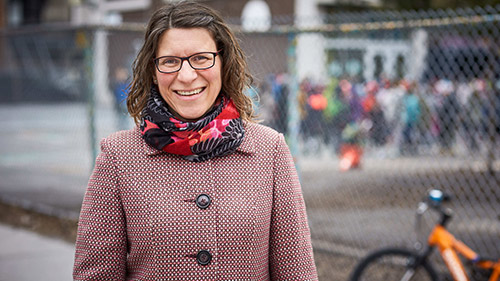
Marie-Soleil Cloutier, Professor at INRS
Marie-Soleil Cloutier has been a Professor at the Urbanisation Culture Société Research Centre of the Institut national de la recherche scientifique since January 2009
After completing a master’s degree in Geographic Information Systems at UQAM, she obtained a PhD in Geography at the Université de Montréal. Her expertise in health geography and urban studies is leveraged through research interests focused on road risk for the most vulnerable city residents (children, seniors, young families).
She heads the Laboratoire Piétons et Espace urbain, the Urbanisation Culture Société Research Centre at INRS, and is co-scientific director of the Smart Pedestrian Cities Laboratory. She regularly collaborates on research projects with local parties (municipalities, public health departments, etc.) as well as with researchers in Quebec, Canada and France.
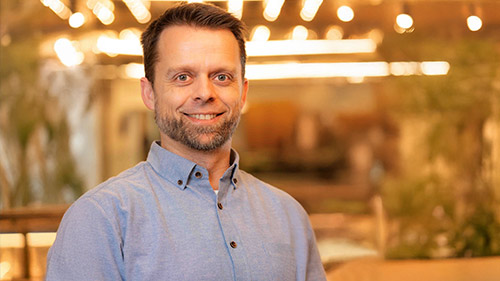
Martin Lavallière, Professor, Université du Québec à Chicoutimi
Martin Lavallière has been a professor in the Department of Health Sciences at the Université du Québec à Chicoutimi since August 2016.
After completing a master’s and doctorate in kinesiology at Université Laval, he undertook a post-doctorate at the Massachusetts Institute of Technology AgeLab and a second post-doctorate at HEC Montréal. His expertise in motor learning and control, as well as in road safety, is channelled into his research interests, which focus primarily on behaviours on the road network and intervention programs aimed at reducing collision involvement among various population groups (aging drivers, first responders).
He regularly collaborates on research projects with healthcare and government bodies, as well as with researchers in Quebec, Canada, and even Chile.
Analysis and writing:
Myriam Paré and Virginie Tutenuit
Many thanks to the student interns who contributed to the data collection:
Isaac Laguna, Rodia Tesselimi, Elisabeth Peña, Myriam Paré, Virginie Tutenuit, Camille Antonuk, Alice Hiron, Julianne Turgeon, Alexis Beaulne, Lili Beauchamp et Nathan Mascaro
Evaluation of Driver-Assistance Technology Systems
Studying technology to ensure it is better used
Given Quebec’s aging population, the various options for keeping our seniors behind the wheel under safe conditions for as long as possible must be evaluated.
Evaluation of driver-assistance systems will enable recommendations as to which should be used to compensate age-related cognitive or physical shortcomings.
Results available upon request
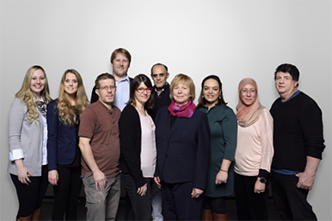
The joint TÉLUQ / LICEF (the Laboratory in Cognitive and Environmental Computing for Education at TÉLUQ, Quebec’s distance-learning university) research team includes:
Évelyne Vallières, Professor of Psychology, TÉLUQ
Perrine Ruer, PhD candidate who is investigating the usefulness of selected types of onboard driver-assistance systems
Investigating Tolerance Among Quebec Drivers
Evaluating trends in our community
In the early years of the Foundation, a social study was conducted to gauge Quebecers’ degree of knowledge of road safety and their tolerance of unsafe road behaviours.
The study also enabled better knowledge of the audience for Foundation and consequent adaptations to its awareness content.
Major observations
“It’s not me, it’s the other guy.”
Driving moderately faster than the speed limit is socially acceptable.
The road safety record is little known.
The culture surrounding unsafe road behaviour in Quebec is surprisingly uniform.
Full research report (in French only)
Nathalie Beaulieu, road safety researcher
Nathalie Beaulieu did her master’s studies on analysis of road signage use strategies and, at the same time, joined the Road Safety Research Group of Université Laval’s Information and Communications Department.
She worked on several files there, including knowledge of road signage, factors determining actual driving speeds, the impact of automotive advertising that performance, road rage, and more.
Her PhD thesis in Humanities, completed in 2009, sought to better understand the role of habitual behaviours in driving.
Impacts of the Foundation’s Actions in Secondary School
Evaluating performance to ensure continued relevance
Following the initial awareness tours of secondary schools, the Foundation took the time to assess the concrete impact of these workshops on young people’s knowledge and behaviours.
Major observations
Using a combination of theory presentations and practical tests on a driving simulator rather than theory alone, the retention rate of information conveyed to teens who took the workshops was higher by 16% on average.
Full research report, 2012 (in French)
Full research report, 2017 (in French)
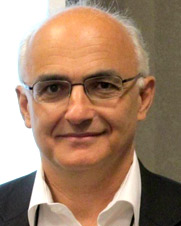
Pierro Hirsch, road safety researcher
Pierro Hirsch has been studying the effects of driver education on driving behaviour, as well as accident risk, since 1976.
He completed undergraduate studies at UC Berkeley, went on to obtain a Master’s as well as a PhD from Université de Montréal, and completed a post-doctoral fellowship at HEC Montréal.
His doctoral research focused on increased accident risk factors among teen and beginner drivers during their first year of unsupervised driving after obtaining their permits. His post-doctoral work involved development of a driving simulator for teaching risk perception.
Autonomous electric shuttle pilot projects in Montréal and Candiac
Assessing user perceptions and behaviours
Understanding the perceptions and behaviours of shuttle users: customer experience, frequency of use, potential for sustainable mobility, etc.;
Documenting the behaviours of pedestrians, cyclists and motorists in the presence of the autonomous shuttle on the road network; and
Gaining insight into the perceptions of shopkeepers and residents along the routes: sharing the road, compliance with the Highway Safety Code, use of the service.
Key findings
The study clearly demonstrated that this type of shuttle addresses a need while ensuring a positive and safe experience for users.
The results of trials carried out during summer 2019 show that respondents (66% in Candiac and 70% in Montréal) are in favour of using this technology.
They also reveal that nearby residents seem to be quite at ease with the shuttle and have a feeling of safety toward it.

Marie-Soleil Cloutier, Professor at INRS
Marie-Soleil Cloutier has been a Professor at the Urbanisation Culture Société Research Centre of the Institut national de la recherche scientifique since January 2009.
After completing a master’s degree in Geographic Information Systems at UQAM, she obtained a PhD in Geography at the Université de Montréal. Her expertise in health geography and urban studies is leveraged through research interests focused on road risk for the most vulnerable city residents (children, seniors, young families).
She heads the Laboratoire Piétons et Espace urbain, the Urbanisation Culture Société Research Centre at INRS, and is co-scientific director of the Smart Pedestrian Cities Laboratory. She regularly collaborates on research projects with local parties (municipalities, public health departments, etc.) as well as with researchers in Quebec, Canada and France.
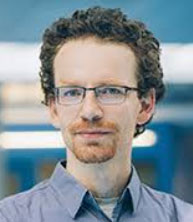
Nicolas Saulnier, Full Professor, Polytechnique Montréal
Nicolas Saulnier holds an engineering degree and a PhD in Computer Science from Télécom Paris. He worked for four years at the Institut National de Recherche sur les Transports et leur Sécurité (INRETS, today IFSTTAR and now part of the Université Gustave Eiffel) for his PhD, followed by four years at the Department of Civil Engineering at the University of British Columbia (UBC) with Professor Tarek Sayed. He completed a four-month sabbatical in 2015 at the Transport and Roads research group of Lund University.
Recruited in 2009 to the Civil, Geological and Mining Engineering Department at Polytechnique Montréal, he is currently a Full Professor in Transportation Engineering. Specializing in artificial intelligence, his fields of interest encompass active and intelligent transportation, road safety and data science for transportation.
Note
The Foundation encourages dissemination of its research results.
Any reference made to these documents must, however, cite the source: Fondation CAA-Québec / CAA-Quebec Foundation.
Road safety research: the Foundation is not alone
Other foundations are actively advancing the cause of road safety. Such is the case of the AAA Foundation for Traffic Safety (AAAFTS), established in 1947. Its mission: to identify road safety issues, support research in this field, and distribute relevant information and educational materials.
Activities and current issues
The CAA-Quebec Foundation funds and organizes activities for both young people and seniors. It also contributes to spreading information about road safety.